


news
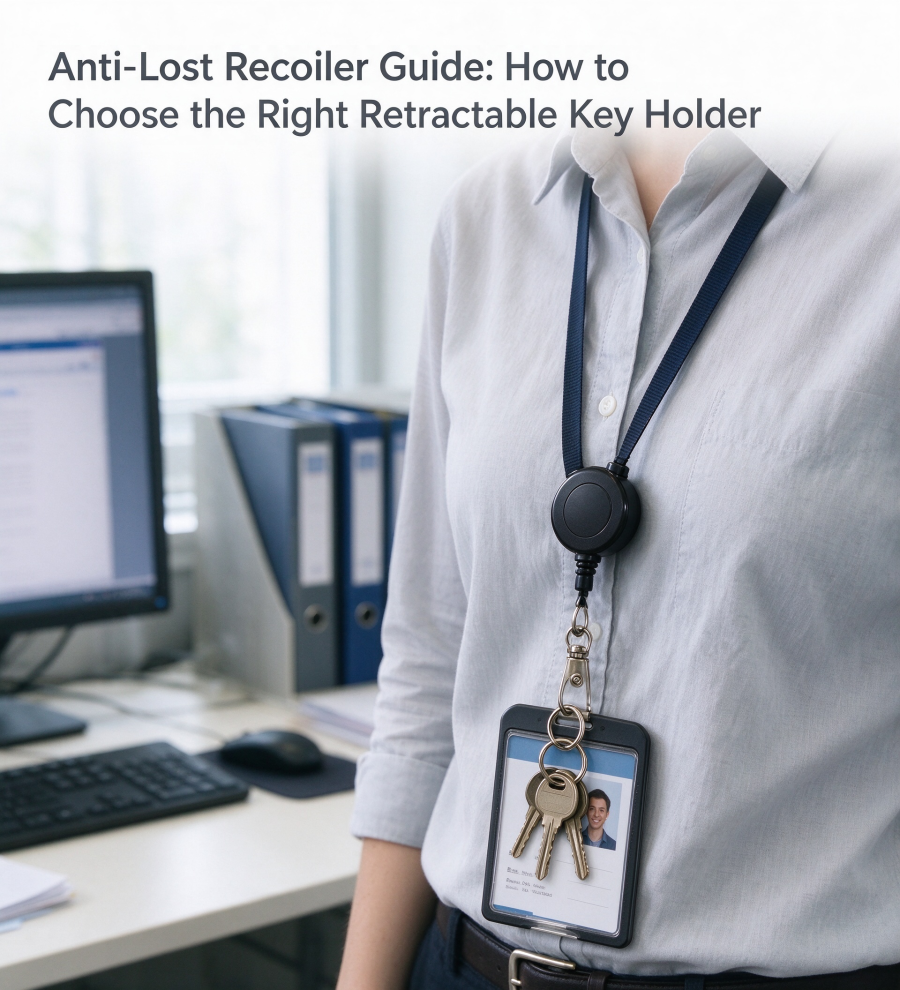
Anti-Lost Recoiler Guide: How to Choose the Right Retractable Key Holder
You reach for your work badge at the door, and the cord snaps back too hard. Or you unhook your keys from your belt, and the clip slips off. A cheap retractable key holder can turn a simple task into a daily annoyance. The right anti-lost recoiler keeps your ID, keys, or small tools close by without getting in your way. The wrong one fails when you are rushing through a scanner, reaching for a door, or pulling a tool from your pack.
This guide will help you match clip security, cord length, spring tension, and weight rating to your actual daily carry setup. Use the included checklist to match an anti-lost recoiler to your daily carry setup before you buy.
Key Takeaways:
- An anti-lost recoiler uses a spring-loaded cord inside a small housing to extend and retract your item.
- The main types are badge reels for work, keychain reels for everyday carry, and heavy-duty reels for tools and outdoor gear.
- Always match cord length, clip style, and weight rating to your real-world reach and carry setup.
- Simple care like cleaning and spring checks can help a recoiler last longer, but frayed cords and loose clips mean it is time to replace it.
What Is an Anti-Lost Recoiler and How Does It Work?
An anti-lost recoiler is a small retractable device that holds an ID badge, key, or light tool on a spring-loaded cord. It lets you pull the item away from your body when you need it, then it pulls the item back to you when you let go. The point is simple: your item stays attached even if you drop it or forget to put it back.
How the Retractable Mechanism Works
Inside the housing, a coiled spring sits around a small spool. When you pull the cord, the spool turns and the spring tightens. When you release the cord, the spring retracts and the cord winds back into the housing. The spring recoil mechanism is what creates that smooth pull-and-return motion.
A good recoiler feels balanced. The cord extends without too much resistance and retracts without snapping back hard. A weak spring leaves the cord hanging loose. A spring that is too strong yanks the item back too fast. Both problems make the recoiler uncomfortable to use every day. That balance matters more than most people expect: an overly strong spring adds extra wear to the internal spool and cord every time it snaps back, while a weak spring forces you to manually push the cord back in. Over dozens of scans or pulls a day, that small friction becomes a real annoyance.
The cord material also matters. Many badge reels use a thin nylon cord. Heavy-duty models often use a stainless steel cable that resists fraying and cuts. The cord attaches to your item through a small loop, split ring, or buckle.
Common Places You Will Use an Anti-Lost Recoiler
You will see anti-lost recoilers most often in workplaces. Hospital staff, warehouse workers, and office employees use them for ID badge holder access. You may also use one for:
- Scanning an access card at a door or turnstile
- Carrying keys on your belt loop or bag strap
- Holding a small tool like a box cutter or pen
- Keeping a transit pass reachable on a backpack
The recoiler works best when the item is light and the reach is predictable. You are not fighting the mechanism. You just pull, scan or use the item, and let it return. Think of a nurse moving between patient rooms. Each doorway may need a badge scan, and the recoiler has to work the same way on the first pull and the fiftieth pull. If the tension is too weak, the badge dangles after a few uses. If it is too strong, the badge snaps back against your chest and you start dreading every door.
Types of Anti-Lost Recoilers You Can Choose
Anti-lost recoilers are not all the same. Matching the type to your use case makes a bigger difference than buying the first retractable badge reel you find. The key is to separate light-duty badge use from key or tool carry, because the spring, cord, and clip are built around very different loads.
Badge Reels for Work IDs
A standard retractable badge reel is lightweight and built for one job: holding an ID card. It usually has a small clear ID strap or loop at the end. The housing is compact, often around the size of a large coin. The spring tension is light because ID cards weigh very little.
Badge reels work best for office workers, hospital staff, and anyone who scans a card many times per day. You can attach one to a lapel, chest pocket, or lanyard. The cord reach is typically 12–36 inches. That is enough for most door scanners without giving you too much slack. A common mistake is treating a badge reel like a general-purpose keychain retractor. Adding a key ring or a small tool to the end of a light spring will quickly wear out the spool and leave the cord hanging.
Keychain Reels for Everyday Carry
A keychain retractor is a small recoiler designed for keys or small everyday carry items. It often clips to a belt, backpack strap, or molle webbing. Some models use a carabiner clip instead of a plastic belt clip for a more secure hold.
Keychain reels are compact, but they need stronger spring tension than badge reels because keys are heavier. A weak spring will sag under the weight of a few keys. A good keychain reel keeps tension without making it hard to pull. The reason is not just static weight. Keys swing and bounce as you walk, and each bounce puts a brief extra load on the spring and cord. A reel with too little tension will gradually lose its retraction, so you end up with a loose cord that catches on doorknobs and edges.
Heavy-Duty Reels for Tools and Outdoor Gear
Heavy-duty reels use stronger cords, metal housings, and more powerful springs. They are built for tools, multi-tools, or small gear that gets pulled harder and used outdoors. Many use a stainless steel cable instead of nylon. Some include a belt clip with locking teeth or a heavy carabiner.
A heavy-duty recoiler is a better choice if you work in a warehouse, service job, or outdoor environment where your gear takes hits, dirt, or moisture. The weight rating is higher, and the attachment is more secure. A light badge reel cannot handle that kind of daily stress. The stronger housing also protects the spring from accidental knocks against equipment or walls, which would crack a thin plastic shell and expose the internal parts to dust.
How to Choose the Right Anti-Lost Recoiler
Choosing the right recoiler comes down to three practical checks: reach, attachment security, and weight capacity. Skip these and you may end up with a recoiler that fails at the worst moment.
Match Cord Length to Your Reach
The cord must be long enough to reach the scanner, door, or workstation without unhooking the recoiler. If you have to lean or twist every time you scan a badge, the cord is too short. If the cord drags or gets caught, it is too long.
To find your ideal length, measure the distance from where you attach the recoiler to where you use the item. A belt clip on your hip needs a longer cord to reach a chest-height badge scanner than a chest-mounted badge reel. A key recoiler on a backpack strap needs less reach because your hand is already close.
A common range is 24–36 inches for belt-mounted badge reels and 12–24 inches for chest or strap-mounted reels. Think about your most frequent motion. You want the cord to reach naturally, not force you to stretch every single time. For example, a warehouse worker who clips a badge reel to a hip belt and scans at a waist-level scanner may only need 18 inches, while a hospital worker reaching up to a wall-mounted reader from a chest pocket may need the full 30 inches. Buying the longest cord you can find is a common mistake because the extra slack tends to swing into door frames, cart handles, or other people.
Check Clip Security and Carry Style
The clip is the weakest point on many cheap recoilers. A flimsy plastic clip can pop off your belt when you pull the cord. A loose carabiner can detach from a bag loop. Before you buy, check how the recoiler attaches to your body or gear.
Ask these questions:
- Will the clip hold onto your belt, pocket, or bag strap during a hard pull?
- Does the clip have teeth or a locking gate, or is it just a flat plastic tab?
- If you use a carabiner, is it rated for more than a light accessory?
For work ID use, a sturdy plastic clip may be fine if you wear it on a lanyard or chest pocket. For keys or tools, a carabiner clip or locking belt clip is usually safer. If the recoiler will sit on a molle strap or bag, make sure the clip opens wide enough and stays closed under tension. One of the most common failures happens when a thin plastic clip is forced onto a thick work belt. The clip barely opens wide enough, the plastic flexes, and the whole reel pops off the first time you pull the cord quickly.
The carry style also affects comfort. A heavy-duty recoiler on a thin shirt pocket pulls the fabric down. A small badge reel on a thick belt may not open wide enough. Match the attachment to how you actually carry your gear.
Read the Weight Rating Before You Trust It
Every recoiler has a weight rating. Some are made for 2 ounces. Some handle 8 ounces or more. The rating matters because the spring must pull your item back after each use. If the item is too heavy, the spring cannot retract it. The cord dangles and gets caught on things.
Compare the weight rating to the actual items you plan to carry. A few keys may weigh 1–3 ounces. A small multi-tool can weigh 5–8 ounces or more. A badge plus a clear sleeve is light, but adding a wallet card case or tax token can push it past a light spring.
A good rule is to leave a margin. If your items weigh 3 ounces, do not buy a recoiler rated for exactly 3 ounces. Choose one rated for at least 5–6 ounces. That extra capacity keeps the retraction smooth as the spring ages and the cord picks up minor friction. The rating is also a static number, but real use involves quick pulls and small shocks. A 3-ounce key ring can briefly create more than double that force when you yank it out at an angle. Building in a margin protects the spring from those repeated spikes.
Simple Care Steps That Help Your Recoiler Last
A recoiler is a small mechanical device. It will last longer if you handle it with basic care. Most failures come from dirt buildup, spring wear, or cord damage. None of those fix themselves.
Quick Cleaning and Spring Checks
Keep the cord and housing free of dirt and debris. Dirt inside the housing adds friction. That weakens retraction and wears out the spring faster. Wipe the outside of the housing with a dry cloth when it looks dusty. If the cord is dirty, wipe it down too. Do not soak the housing in water unless the model is sealed. A dry cotton swab works well for clearing the cord opening, and a short burst of compressed air can remove fine dust from the housing seam. Avoid using oil or spray lubricants because they attract more dirt and can make the internal parts stick.
Test spring retraction regularly. Pull the cord out to its full length and let it go. For a badge reel, the cord should retract fully and smoothly. If it returns slowly, sticks halfway, or hangs loose, the spring is weakening. For a keychain or heavy-duty reel, the pull should feel firm and the return should be steady. A rough or jerky return usually means dirt inside or a worn spring.
Signs It Is Time to Replace the Recoiler
Replace the recoiler if the cord frays, the spring sticks, or the clip becomes loose. A frayed nylon cord can snap at the worst time. A sticking spring makes the recoiler unreliable. A loose clip means your item is one hard pull away from falling off.
Other signs include a cracked housing, a cord that does not fully retract, or a carabiner that no longer closes tightly. Do not wait for a complete failure. If the recoiler cannot hold your item securely or retract it smoothly, it is no longer doing its job.
Your Anti-Lost Recoiler Decision Checklist
Before you buy, run through a quick five-question checklist. Then test the recoiler before you trust it with anything important.
A 5-Question Buying Checklist
Ask yourself these questions in order:
- What am I carrying? Decide if it is a badge, keys, a small tool, or a mix.
- How much does it weigh? Use a kitchen scale if you are not sure. Pick a recoiler with enough margin above that weight.
- Where will I attach it? Belt, chest, pocket, bag strap, or molle. Match the clip or carabiner to that spot.
- How far do I need to reach? Measure from the attachment point to where you use the item.
- What is my environment? Indoor office, hospital, warehouse, or outdoor use. Choose a heavier build if there is dirt, moisture, or rough handling.
If you cannot answer any of these questions, hold off. A recoiler is a simple product, but the weak points are always the same: clip, spring, cord, and weight rating. Confirm those four match your daily carry before you spend money.
Try This First-Use Test
Once the recoiler arrives, test it before you attach anything valuable.
- Extend the cord fully and check for smooth retraction.
- Attach your actual item and pull it through your normal motion.
- Tug on the clip or carabiner to make sure it stays put.
- Let the recoiler dangle and pull your item at your normal reach.
If the retraction feels weak, the cord hangs, or the clip slips, return it and look for a better match. A recoiler that passes your first-use test will be easier to trust every day.
Frequently Asked Questions
What is the difference between a badge reel and a heavy-duty anti-lost recoiler?
Badge reels are lightweight and designed for ID cards, with thin nylon cords and low spring tension. Heavy-duty anti-lost recoilers use stronger springs, metal or reinforced housings, and often stainless steel cables. If you carry keys or tools instead of a badge, choose a heavy-duty model to avoid spring fatigue and cord fraying.
How long should a retractable badge reel cord be for belt-mounted use?
For a belt-mounted badge reel, 24–36 inches is usually enough to reach a chest-height scanner without excessive slack. For chest or strap-mounted reels, 12–24 inches generally works better. Measure from your actual attachment point to where you regularly scan or use the item before buying.
What weight rating should I look for in a retractable key holder?
Weigh the keys or tools you plan to carry, then choose a recoiler rated above that weight by a comfortable margin. For example, if your keys weigh 3 ounces, pick a model rated for at least 5–6 ounces. This extra capacity keeps retraction smooth during quick pulls and as the spring ages.
How do I keep a retractable key holder from falling off my belt?
The clip is often the weakest point, so avoid thin plastic tabs on thick belts. Look for a carabiner clip or a locking belt clip with teeth if you carry keys or tools. Test the attachment with a firm tug before trusting it with anything valuable.
How do I fix a retractable badge reel that won't retract?
First, clean the cord opening and housing seam with a dry cloth, cotton swab, or a short burst of compressed air. Dirt inside adds friction and weakens retraction, so avoid oil or spray lubricants. If cleaning does not help and the cord still hangs loose, the spring is likely worn and the reel should be replaced.
Tags:anti-lost pull box
0users like this.