


news
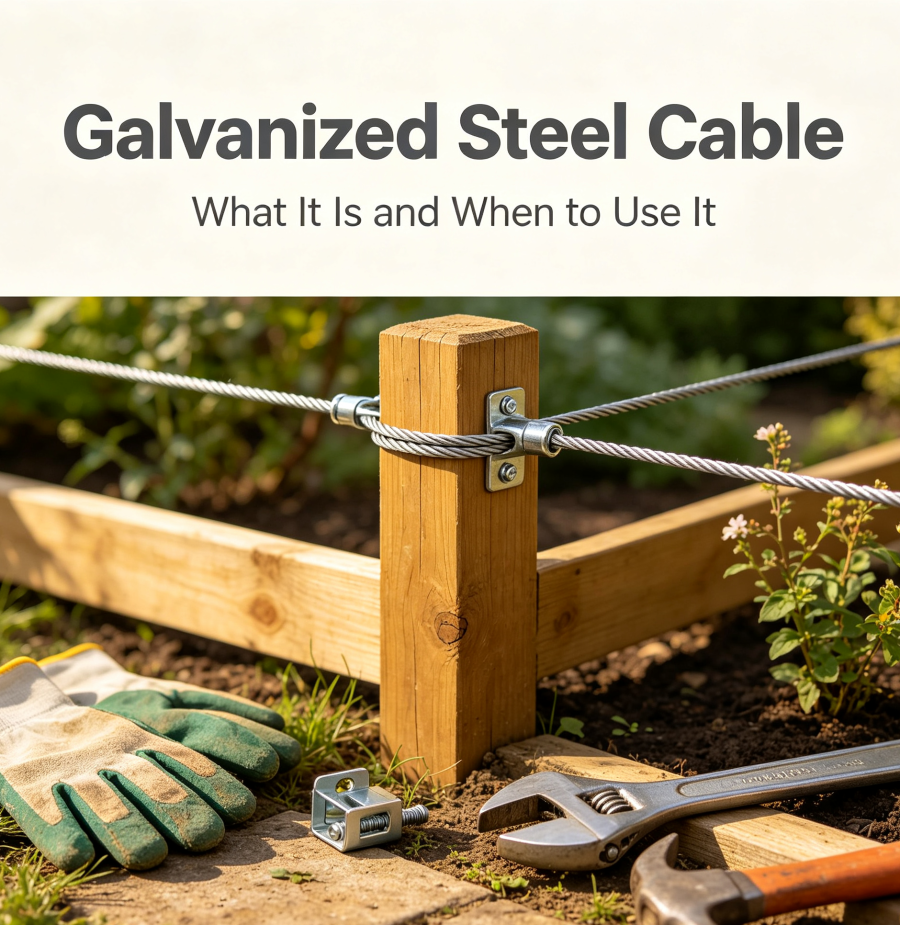
Galvanized Steel Cable: What It Is and When to Use It
If you have ever shopped for wire rope, you have probably seen the term galvanized steel cable and wondered whether it is the right choice for your project. The answer is not always obvious. Galvanized steel cable costs less than stainless steel and works well in many outdoor settings, but it also has real limits. In this guide, you will learn what galvanized steel cable actually is, where it performs best, how to choose the right size and construction, and when you should upgrade to stainless steel. By the end, you will have a clear decision path—not just a spec sheet.
Key Takeaways
- Galvanized steel cable is steel wire rope with a zinc coating that slows rust but does not make it rust-proof.
- It works best in dry or mildly wet outdoor uses such as railings, fences, tie-downs, and overhead lines.
- Working load limit is a fraction of breaking strength—usually around 1:5—so never size cable by breaking strength alone.
- Choose flexible 7x19 cable for pulleys and handrails; choose stiffer 1x19 or 7x7 for straight runs.
- Avoid continuous saltwater or harsh chemical exposure, and inspect regularly for broken wires, rust, and flattening.
What Galvanized Steel Cable Actually Is
Galvanized steel cable is steel wire rope with a protective zinc coating. The zinc layer is the key difference between plain steel wire and galvanized wire rope. It acts as a barrier that keeps moisture and air away from the steel underneath, which helps slow down rust.
How the zinc coating protects the steel
The zinc coating works in two ways. First, it physically blocks water and oxygen from reaching the steel. Second, zinc is sacrificial. That means the zinc will corrode before the steel does. This is why galvanized cable can still look functional for a while even after the coating begins to wear. But once the zinc is gone, the bare steel starts to rust quickly.
The sacrificial property is not a marketing claim—it comes down to basic electrochemistry. Zinc is more reactive than steel, so when moisture creates a tiny electrical circuit at a scratch or cut, the zinc gives up electrons first. The steel underneath stays protected as long as there is zinc nearby. That is also why a small scratch in the coating does not immediately spell disaster. The zinc around the scratch keeps working. The problem is when the zinc is worn away entirely, because there is nothing left to sacrifice.
Think of galvanized steel cable as water-resistant, not waterproof. It handles rain, humidity, and occasional moisture well. It is not made for constant submersion or saltwater spray.
Common cable constructions: 7x7, 7x19, and 1x19
You will see numbers like 7x7, 7x19, and 1x19 when shopping for galvanized cable. These describe how the wire strands are arranged.
- 1x19 is stiff and smooth. It works well for straight runs like railing and architectural uses.
- 7x7 is moderately flexible. It handles light pulley work and general-purpose uses.
- 7x19 is more flexible. It is the best choice for handrails, winching, and applications where the cable bends around pulleys or corners.
Construction affects flexibility, handling, and fatigue life. The reason 7x19 bends more easily is simple: it has more individual wires, and each wire is thinner. Thin wires can flex farther before they fatigue and crack. A 1x19 cable has fewer, thicker wires, so it resists bending. That stiffness can be good for a clean, straight railing line—but bad if you try to run the same cable through a pulley. Every bend forces those thick outer wires to stretch and compress, and repeated bending eventually causes microscopic cracks.
A good rule of thumb from rigging professionals: match the cable to the tightest radius it will ever see. If the cable only goes in a straight line, stiffness is your friend. If it moves, choose flexibility.
Where Galvanized Steel Cable Works Best
Galvanized steel cable is a strong, budget-friendly fit for many outdoor projects—as long as the environment is not too aggressive. It performs best in dry or mildly wet conditions, away from constant saltwater or harsh chemicals.
Outdoor and weather-exposed projects
Use galvanized cable for projects that stay outside but are not constantly soaked. Good examples include overhead shade lines, fence bracing, gate cables, flagpole lines, and general utility tie-downs. Rain and morning dew will not destroy the cable quickly, especially if the zinc coating is intact.
Cable railing, decking, and farm uses
Galvanized steel cable is common in cable railing systems, deck cable runs, animal enclosures, farm gates, and light-duty hoisting or pulling jobs. In these uses, the cable is usually not under extreme tension or constant spraying water, so galvanized material offers a practical balance of strength and cost.
Picture a typical weekend project: you are building a cable railing for a backyard deck in a suburban neighborhood. The deck gets rain and morning dew, but it is not sitting in salt spray. The cable runs are mostly straight with gentle turns at corner posts. In that setting, galvanized 1x19 cable with the right stainless or galvanized fittings will serve for years without complaint. You save money compared to stainless, and the conditions never push the material past its comfort zone.
Avoid continuous saltwater or chemical exposure. If you are building near the ocean, a pool, or a chemical washdown area, stainless steel cable is usually the safer choice. Even a few miles of distance from the coast can make a difference, but once you can taste salt in the air or see corrosion on exposed metal fasteners, galvanized becomes a gamble.
Galvanized Steel Cable vs Stainless Steel Cable
If you are trying to choose between galvanized and stainless, the decision usually comes down to environment and budget. Both can work outdoors, but they fail differently over time.
Cost and corrosion resistance
Galvanized steel cable costs less upfront. That is the biggest reason people choose it. For a fence, farm gate, or temporary outdoor line, the savings often make sense.
Stainless steel cable resists corrosion better, especially in wet, salty, or chemically active environments. It does not rely on a coating that can scrape away. The corrosion resistance is built into the alloy itself.
The reason for this difference matters. Galvanized cable depends entirely on a thin zinc layer. Once that layer is worn through by abrasion, bending, or years of weather, what is left is ordinary steel. Stainless steel, by contrast, contains chromium that forms a passive, self-healing oxide film on the surface. That film does not peel away like a coating. If it is scratched, it reforms in the presence of oxygen. The tradeoff is price. Stainless typically costs more, sometimes significantly more. But if you install galvanized cable in the wrong environment, you may replace it sooner—and labor often costs more than the cable itself.
One costly mistake is comparing prices by the foot and ignoring replacement labor. Imagine installing a 40-foot deck railing with galvanized cable to save $80 on materials, then paying an installer or spending your own weekend replacing it three years later. The math flips in stainless steel's favor almost every time when labor is involved.
When to upgrade to stainless
Upgrade to stainless steel cable if the cable will face any of these conditions:
- Constant saltwater or salt spray
- Regular submersion or standing water
- Pool chemicals, fertilizers, or industrial chemicals
- High-visibility architectural work where rust staining would be unacceptable
- Long service life with minimal maintenance
For most dry outdoor and light moisture uses, galvanized cable is a reasonable choice. For anything harsher, stainless is worth the extra cost.
How to Choose the Right Galvanized Steel Cable
Choosing a cable is easier when you work through three steps: diameter, construction, and load rating. Do not skip any of them.
Diameter and construction
First, check the diameter your hardware or project requires. Many railing posts, clamps, and ferrules are sized for a specific cable diameter. If you guess, you can end up with fittings that do not hold.
A frequent mistake is buying the cable first and the fittings second. That order almost guarantees a mismatch. You see a spool of 1/8-inch cable on sale, bring it home, and then discover your railing posts are drilled for 3/16-inch fittings. Or you buy aluminum ferrules that are too large for the cable diameter, so the swage does not bite properly and the cable slips under load. The better sequence is to check your hardware limits and project requirements first, then buy cable and fittings together from the same spec.
Next, match the construction to the movement in your project.
- Use 1x19 for straight, static runs such as railing and architectural lines.
- Use 7x7 for light-duty general uses where some flexibility helps.
- Use 7x19 for pulleys, winches, handrails, and any cable that bends during use.
Matching cable to your load
Never pick a cable based on "it looks strong enough." Instead, find the rated breaking strength of the cable and compare it to your actual working load.
For example, if a cable has a breaking strength of 4,000 lb, that does not mean you should apply 4,000 lb to it. You need a safety factor. The next section explains how to apply that correctly.
Also consider dynamic loads. A load that jerks, swings, or vibrates can spike well above its static weight. Cable that is fine for a steady pull can fail under sudden movement. Think about a gate that slams shut in the wind or a tree limb that drops onto a fence line. Those are dynamic events, and they multiply the force the cable experiences.
Strength Ratings: Working Load Limit vs Breaking Strength
One of the easiest mistakes to make with galvanized steel cable is reading the breaking strength and treating it as the working limit. These are not the same thing.
Breaking strength basics
Breaking strength, sometimes called minimum breaking strength, is the load at which the cable is expected to fail in a straight pull. It is a tested or calculated value based on the cable's diameter, material, and construction.
A 3/16-inch galvanized cable may have a breaking strength of several thousand pounds. That sounds like a lot. That number represents failure—not safe operation.
Applying a safe working load factor
Working load limit is a fraction of breaking strength. A common rule is a 5:1 safety factor. That means you divide the breaking strength by 5 to get a safe working load.
For example:
- Breaking strength: 4,000 lb
- Working load limit at 5:1: 800 lb
Why so much margin? Because the breaking strength is measured under ideal conditions: new cable, straight pull, no knots, no bent fittings, no wear, no shock loading. Real-world conditions are rarely ideal. Clamps and swages reduce strength at the ends. Bends reduce strength along the run. Corrosion and wear reduce it over time. A sudden jerk can momentarily exceed the static load several times over. The safety factor accounts for all of these unknowns without requiring you to become an engineer.
A 5:1 factor is common for many non-critical uses. Some applications, such as lifting people or suspending loads overhead, require higher safety factors and engineering approval.
Never use galvanized steel cable for lifting people without engineering approval. That is a line you should not cross. Human safety loads are regulated, and the hardware, inspection requirements, and design factors are much stricter than a farm gate or railing project.
Installation and Care Tips That Prevent Early Failure
Most galvanized cable failures happen at the ends or at sharp bends—not in the middle of a straight run. Good installation habits make a big difference.
Using the right fittings
Match every fitting to the cable size and coating. A ferrule made for a different diameter will not swage correctly. That creates a weak point.
Use thimbles wherever the cable loops around a fitting or anchor point. A thimble supports the loop shape and reduces sharp bending at the eye. Without a thimble, the cable has to make a tight U-turn around a bolt or anchor pin. That sharp bend concentrates stress on a small area of wire strands. Over time, or under load, individual wires start to crack right at the bend. The thimble spreads that bend over a larger radius and keeps the eye from collapsing when tension is applied.
Swage the ferrule or fitting properly with the correct tool. Avoid hammering ferrules flat and hoping they hold. The difference between a pressed swage and a hammered one is not cosmetic. A proper swage tool compresses the ferrule evenly around the cable so it grips every strand with uniform pressure. Hammering deforms the ferrule unevenly, leaving internal gaps and stress concentrations. It may hold initially, but it is a hidden weak point that can release without warning.
For railing and structural uses, follow the hardware manufacturer's spacing and tensioning instructions. Over-tensioning can damage posts and shorten cable life. A common mistake is assuming that tighter is always better. Over-tensioned railing cables can bow posts inward, strip threaded fittings, and put constant stress on the cable itself. The system becomes a loaded spring, and any small failure becomes dramatic.
Inspection and maintenance
Inspect galvanized steel cable regularly. Look for:
- Broken wires sticking out from the strand
- Flattened or crushed sections
- Rust that reaches the steel underneath the zinc
- Signs of wear at pulleys, corners, or anchor points
If you see broken wires or rust that has gone deep, replace the cable. A cable that has lost several wires in one area can fail without much warning.
For outdoor galvanized cable, keeping it clean and dry helps. You can wipe it down occasionally and check that drainage does not let water pool against the cable or fittings. Water pooling is one of those small details that shortens cable life more than people expect. The zinc layer is not designed for continuous immersion, so even a small low spot where water sits can accelerate corrosion locally.
Is Galvanized Steel Cable Right for Your Project?
Galvanized steel cable is a smart choice when you need a budget-friendly steel wire rope for outdoor or utility use away from saltwater and harsh chemicals. It works well for cable railing, fences, tie-downs, overhead lines, and many farm or light-duty pulling jobs.
Choose galvanized if your project meets these conditions:
- Outdoor or indoor use in dry or mildly wet environments
- Static loads or light bending around pulleys
- Budget is a priority
- The cable can be inspected and replaced if needed
Upgrade to stainless steel if the cable must handle constant moisture, saltwater, pool chemicals, or corrosive industrial environments. Stainless costs more, but it lasts longer when the conditions are rough.
Before you buy, take the time to check your diameter, construction type, and working load limit—not just the breaking strength. A little planning here keeps your project safe and saves money later.
Imagine standing in the aisle or scrolling through an online catalog with two cables in front of you: a galvanized spool and a stainless spool. Your project is a backyard deck railing in a normal suburban neighborhood. You have checked your post spacing, you know you need 1x19 construction, and your working load is well under the limit at a 5:1 factor. In that situation, galvanized is not a compromise—it is the right tool at the right price. The moment the project shifts to a coastal dock or a poolside railing, though, the right tool changes. Knowing the difference is what saves you from a costly redo.
Use this guide as your selection checklist before you buy. It walks you through diameter, construction, and working load decisions so you do not miss a step.
Frequently Asked Questions
What's the difference between galvanized steel cable and stainless steel cable?
Galvanized cable relies on a zinc coating that can wear away, so it's best for dry or mildly wet outdoor use. Stainless steel has built-in corrosion resistance from chromium and handles saltwater and chemicals much better. If rust or long-term durability is a concern, stainless steel cable is worth the extra cost.
Can galvanized steel cable be used outdoors?
Yes, galvanized steel cable works well outdoors in dry or mildly wet conditions like deck railings, fence bracing, and overhead lines. It is water-resistant, not waterproof, and should not be used in constant saltwater spray or chemical exposure. For coastal or poolside projects, stainless steel is safer.
How much weight can galvanized steel cable safely hold?
You should never use breaking strength as the safe working load. A common rule is a 5:1 safety factor, so divide the breaking strength by 5 to get the working load limit. For example, a cable rated at 4,000 lb breaking strength should only be loaded to about 800 lb in most applications.
What is the difference between 1x19 and 7x19 galvanized cable?
1x19 cable is stiff and smooth, making it best for straight runs like railing and architectural lines. 7x19 cable has thinner wires that flex more easily, so it is better for pulleys, winches, and handrails that bend. Choose based on the tightest radius the cable will need to handle.
How do you install galvanized steel cable correctly?
Always match fittings and ferrules to the cable diameter, and use thimbles wherever the cable loops around an anchor to reduce sharp bends. Swage ferrules with the correct tool instead of hammering them flat, and avoid over-tensioning the cable. Regular inspection for broken wires or deep rust is also essential.
0users like this.
