


news
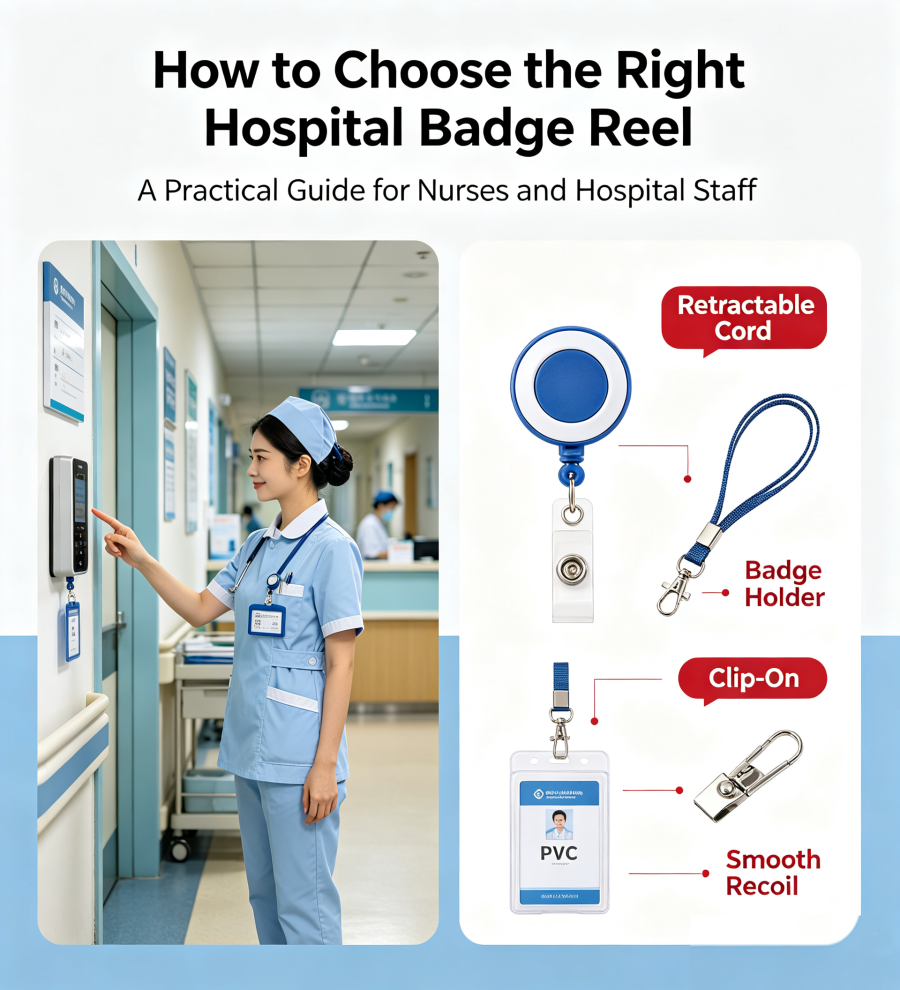
How to Choose the Right Hospital Badge Reel: A Practical Guide for Nurses and Hospital Staff
A hospital badge reel seems like a small purchase, but on a hospital floor it quietly decides whether your shift starts with a smooth beep or an awkward fumble. Picture this: you are walking into the med room with an armload of supplies, the door is about to lock behind you, and your badge is clipped to your waistband. You reach down, pull it toward the reader, and the cord stretches but does not retract. That is the moment you realize a small accessory has been quietly failing for weeks. You already carry enough. Your ID should not be one more thing to track. This guide walks through how to choose a hospital badge reel by role, work area, scrub attachment point, infection-control needs, and the failure points that usually show up at the worst possible moment. You will finish with clear criteria, not just another list of cute designs.
Key Takeaways
- Match the reel to your department and shift flow first, then worry about style.
- Clip type matters because a collar, pocket, and waistband each create different stress on the reel.
- Smooth, wipeable surfaces hold up better to disinfectants than fabric or deep seams.
- Watch for early warning signs like slow retraction or a loose swivel before the reel fails mid-shift.
- Download the free Hospital Badge Reel Selection Checklist at the end to compare features side by side.
What a Hospital Badge Reel Actually Does for You on Shift
A hospital badge reel is a retractable badge holder that keeps your ID badge attached to your scrub uniform while letting you pull it toward a scanner or reader. It is a simple tool, but it does two jobs: it keeps the badge from being set down and lost, and it cuts the seconds it takes to scan into a door, med room, or charting station. Over a twelve-hour shift, you might scan your badge twenty, forty, or even sixty times depending on your unit. Multiply that across a week, and the reel becomes one of the most-used pieces of equipment you carry.
Why a Badge Reel Is More Than a Cute Add-On
The reel is not a decoration. It is a small piece of your workflow. When the cord pulls smoothly and retracts cleanly, you do not think about it. When it does not, you notice every single time you need access. A reliable retractable badge holder reduces the chance of leaving an ID badge at a computer, on a supply cart, or in a break room. Think of it as a small piece of infrastructure: unremarkable when it works, costly when it fails. The seconds you save per scan may seem trivial, but they add up. More importantly, they keep your focus on the patient rather than on retrieving a badge that slipped behind a cart.
When You Reach for It Most
You reach for your badge reel when your hands are full, when a door locks behind you, when a patient is waiting, and when an order needs to happen now. You also reach for it during isolation precautions, when you are gloved and gowned and cannot easily fumble through a pocket. In those moments, the reel either supports you or adds friction. If the cord overextends, the clip slips off, or the back plate cracks, the cost of a cheap reel becomes obvious. The issue is rarely the reel. It is the timing. Reels do not fail when you are sitting at a desk. They fail when you are moving fast, reaching across a bed, or pulling a badge through a cracked door.
How to Match a Hospital Badge Reel to Your Role and Work Area
Start with where and how you work. A nurse in the emergency department and a lab technician moving between benches do not need the same reel, even if they both scan badges. The right reel matches the physical demands of your specific role, not just your personal style.
Choose Based on Department and Shift Flow
In fast-paced units like the ER and ICU, you need a reel with a stronger retraction spring and a secure clip. You are scanning constantly, moving quickly, and sometimes brushing against bed rails, monitors, and door frames. A flimsy alligator clip can pop off a collar during a rapid response. Think about the specific motion: in the ER, you often scan at a wall reader while standing, then turn quickly to walk away. The reel needs to retract fast enough to keep the badge from swinging into equipment, but not so aggressively that it snaps back and hits your chest.
In surgical or procedural areas, simplicity and cleanability matter more than style. You may need a badge reel that attaches to a badge card or waistband without dangling fabric or braided cord that traps debris. In these environments, the reel often sits under a gown or near sterile surfaces, so anything that collects fibers or lint becomes a problem.
In lab, pharmacy, or admin settings, you move less but still scan frequently. A standard retractable badge holder with a smooth plastic or metal case usually works. The main concern is that the cord does not stretch out after months of daily pulls. Here, the failure tends to be gradual: the cord loses tension, the badge sags, and you compensate by pulling farther than you should. That extra strain accelerates wear.
Choose Based on Your Scrub Attachment Point
The way you wear your badge changes which clip makes sense. If you attach the reel to a collar or V-neck, look for a secure alligator clip with teeth that grip without cutting fabric. Thin scrub material frays easily. A clip with sharp, aggressive teeth may hold well at first but gradually chew through the fabric, especially if you remove and reattach the reel every day for washing. If you prefer a pocket, a swivel clip or slide-on clip can sit flatter and keep the badge from swinging forward every time you lean over a patient. For a waistband or belt-loop attachment, a carabiner-style or reinforced loop may hold better than a standard clip.
A reel with a swivel clip helps keep the cord from twisting as you move. If the clip does not swivel, the cord can bunch up and eventually stop retracting cleanly. That is a small detail that becomes a daily annoyance. The twisting tends to happen gradually. You might notice the cord looks wavy or curled after a few weeks. That is the first sign the clip is not rotating properly and the cord is taking up the twist instead.
The Features That Matter Most in a Hospital Badge Reel
Three features do most of the work: cord length and retraction strength, the attachment clip and swivel, and the materials with breakaway safety. Get these right and the design questions get much easier. One common mistake is choosing a reel based on the printed design or the shape of the case before checking the hardware. A cute reel with a weak clip is still a weak reel. Start with function, then filter by style.
Cord Length and Retraction Strength
Most hospital badge reels have a cord between 24 and 36 inches. A shorter cord forces you to lean toward the reader. A longer cord gives more reach but can snag on handles and equipment. For most clinical roles, a middle-range retractable cord with smooth, consistent retraction is the safest default. The ideal length depends on where you mount the reel. If it sits on your shoulder, you may only need 24 inches. If it sits at your waist, 30 to 36 inches gives you room to reach a wall reader without bending. But longer cords also mean more slack that can catch on a bed rail, an IV pole, or a door handle.
Retraction strength matters just as much. A weak spring means the cord sags after a few weeks. A strong spring snaps the badge back quickly, which can be handy but also creates wear. Look for a reel that retracts fully without pulling hard enough to yank the badge off your chest. Here is a quick test you can do before buying: pull the cord out to full length, then let it retract on its own. If it does not fully retract in one smooth motion, the spring is likely underpowered. If it snaps back so hard that the badge clip bounces, the spring may be too aggressive for daily use.
Attachment Clip and Swivel
The clip is the first point of failure on many cheap reels. Alligator clips with thin metal teeth lose grip after repeated clipping to scrub fabric. Plastic slide clips can crack. A reinforced metal alligator clip or a sturdy swivel clip typically lasts longer. The clip is also the part that gets the most manual handling. Every time you take the reel off before laundry or move it to a different scrub top, the clip springs open and closed. Cheap metal fatigues quickly under that repeated motion.
A common mistake is ignoring the clip until it fails completely. You may notice the reel slipping down your collar or shifting on your pocket, but you adjust it and keep going. That is the warning sign. Once a clip loses tension, it will not recover on its own. Replace the reel or the clip before it drops your badge somewhere you cannot easily retrieve it.
A full 360-degree swivel helps the cord stay straight when you twist, bend, or reach across a bed. Without it, the cord can kink near the reel body, and that kink is often where retraction starts to fail. The swivel is a small mechanical joint that takes constant micro-movement. When it starts to feel gritty or loose, the failure is usually not far behind.
Materials and Breakaway Safety
The reel body takes abuse. It gets bumped against carts, wiped with disinfectants, and dropped. Metal cases hold up well but may feel heavier. Hard, smooth plastic cases are lighter and easier to wipe. Avoid soft-touch coatings that break down after repeated sanitizing. Soft-touch finishes, the kind that feel slightly rubbery, often start peeling or turning sticky after prolonged exposure to alcohol-based disinfectants. That tacky surface then collects dirt and becomes harder to clean.
Breakaway or easy-release features matter in patient-facing roles. A reel that snaps a badge off cleanly under pressure can keep you safer if it catches on equipment or a patient. Some hospital systems prefer breakaway release as a standard safety feature. If your facility has a policy, follow that first. The logic is simple: a reel that stays firmly attached is good, but a reel that can release smoothly under a sudden pull is safer in situations where the cord could get caught on a bed, a wheelchair, or a patient's arm.
Infection Control and Daily Cleaning: Pick a Hospital Badge Reel You Can Actually Wipe Down
A badge reel sits on your chest, but your hands touch it constantly. Many product lists skip this part, but in patient-care areas it should be a deciding factor. The reel travels with you from room to room, and your hands go from the reel to the patient, to the computer, to the med cart. Whatever is on the reel surface is now part of that chain.
Why Fabric and Deep Seams Cause Problems
Fabric-covered reels and padded designs may look nice, but they trap moisture, skin oils, and debris. Deep seams around buttons or decorative overlays create small spaces that are hard to clean. Over a shift, the reel becomes one more surface you keep touching without thinking about it. The problem compounds when the reel gets damp. Sweat from a long shift, hand sanitizer overspray, or a splash from a sink can soak into fabric surfaces. That moisture never fully dries during a busy shift, and it creates a warm, damp environment where bacteria can multiply.
For infection control, choose a reel with a smooth, nonporous body. Hard plastic, sealed metal, and medical-grade silicone with no open seams are easier to disinfect. If the cord is braided or fabric-wrapped, it will hold contamination longer than a smooth nylon-coated cord. Some cords are made from braided Kevlar or woven nylon, which are durable but have a rough surface that traps skin cells and debris. A smooth coated cord is much easier to wipe clean.
How to Clean a Hospital Badge Reel Quickly
You do not need a complex routine. At the end of your shift, wipe the reel body and the clip with the same hospital-approved disinfectant wipe you use for other personal items. Extend the cord fully, wipe it once, and let it retract. Check the back plate and the seam where the cord enters the reel, since that is where grime builds. The seam is the collection point for dead skin cells, lotion residue, and dust that gets pulled in every time the cord retracts.
If your reel has a swivel, move it while wiping so the disinfectant reaches the joint. Let the reel air dry before storing it. A quick wipe takes less than a minute and extends the life of the retraction mechanism. One practical habit: keep a small pack of disinfectant wipes in your locker or bag, and make reel cleaning part of your end-of-shift routine. If you clean your stethoscope, badge, and phone at the end of every shift, add the reel to that same pass.
Common Hospital Badge Reel Failures and How to Avoid Them
Most badge reels do not break suddenly. They give signals first, and those signals are easy to miss until the reel fails at a locked door. Understanding the failure patterns helps you replace a reel before it becomes a problem.
When the Cord Stops Retracting
Early signs include a cord that sags, retracts slowly, or only pulls back if you guide it by hand. The spring inside may be wearing out, or the cord may have twisted inside the housing. Once retraction weakens, the badge is more likely to dangle, snag, or fall. Here is the scene: it is hour nine of your shift, you have just finished a difficult patient transfer, and you are heading to the clean utility room. You pull your badge toward the reader, the cord extends, and it stays extended. Your badge now dangles below your waist. You have to push the cord back into the reel manually while holding an armful of linens. That is what failure looks like in practice.
A reel with a replaceable cord or a design that lets you open the body can be serviced. If the housing is sealed and the cord stops retracting, you are buying another one. That is why durability matters more than a fun print. The sealed design is often cheaper to manufacture, but it means the whole unit is disposable when one internal component wears out.
When the Clip Loses Its Grip
A clip that slips off your collar once is already failing. Check the tension. If the alligator clip opens too easily or the teeth no longer hold scrub fabric, replace the reel or the clip. A swivel that feels loose or gritty will eventually seize or separate. The most common mistake is waiting too long to respond to these signs. A clip that slides down your collar three times in one shift is not something to tolerate. It is a warning that the reel is about to fail completely, probably at the worst moment.
Metal components tend to outlast plastic in high-stress spots. Some reels mix a metal clip with a plastic body, which offers a balance of durability and light weight. If you move fast or wear heavier ID badges with multiple cards, lean toward metal clips and reinforced attachment points. Extra cards add weight. A badge with an RFID card, a parking pass, and a facility ID can weigh several ounces, which is more than many lightweight clips are designed to hold securely over time.
Your Hospital Badge Reel Buying Checklist
You do not need to overanalyze a small accessory, but a few questions will keep you from buying three cheap reels when one practical reel would have done the job. The most common buying mistake is treating a badge reel as a disposable impulse purchase. You grab a cheap one at the register, it fails in three weeks, and you buy another. Over a year, you may spend more on cheap replacements than you would have spent on one well-built reel.
Five Questions to Ask Before You Add to Cart
- Where will I wear it? Collar, pocket, waistband, or badge card? This decides the clip type.
- How often do I scan in a shift? High-frequency scanning means stronger retraction and a smooth cord.
- Will I need to wipe it down daily? If yes, skip fabric and deep seams.
- Does the clip have enough grip for my scrub fabric? Thin fabric needs a gentler but secure clip. Thick fabric needs a wider jaw.
- What fails first on reels I have owned before? If it was always the cord, buy for retraction. If it was the clip, buy for metal or reinforced hardware.
Test It on One Shift Before Buying More
Buy one hospital badge reel, wear it for a full shift, and clean it the same day. Pay attention to the first hour and the last hour. A reel that feels fine in the morning may sag by hour ten. That is the difference between working for a few pulls and working through a full clinical shift. If it passes, buy a backup. If not, you have learned what to avoid without ending up with a drawer full of unworn reels.
Download the free Hospital Badge Reel Selection Checklist to compare features before you buy. It turns this guide into a quick decision tool you can keep on your phone.
Frequently Asked Questions
What is the best type of badge reel for hospital nurses?
Choose a reel with a strong retraction spring, a secure metal or reinforced alligator clip, and a smooth, wipeable body. Cord length should match where you wear it—around 24 inches for a shoulder mount and up to 36 inches for a waistband. Skip fabric-covered designs if you need to disinfect the reel daily.
How do you clean a hospital badge reel without damaging it?
Use a hospital-approved disinfectant wipe on the body, clip, and back plate. Pull the cord out fully, wipe it once, then let it retract and air dry. Avoid fabric or deep-seam designs that trap moisture and debris.
Why won't my retractable badge reel retract?
The internal spring is usually worn out or the cord has twisted inside the housing. You may first notice slow retraction, sagging, or a cord that needs manual help to go back. If the housing is sealed, replacement is usually the simplest fix.
Do nurses need a breakaway badge reel for hospital safety?
Breakaway badge reels release under sudden pull, which can reduce injury risk if the cord catches on equipment or a patient. Patient-facing roles often benefit from this feature, but follow your facility's policy first.
How often should you replace a hospital badge reel?
Replace the reel as soon as the clip loses tension, the swivel feels loose, or the cord stops retracting fully. Waiting for complete failure can leave you without a badge at a locked door, so keep a backup once you find a model that holds up through a full shift.
Tags:badge clip reel
0users like this.