


news
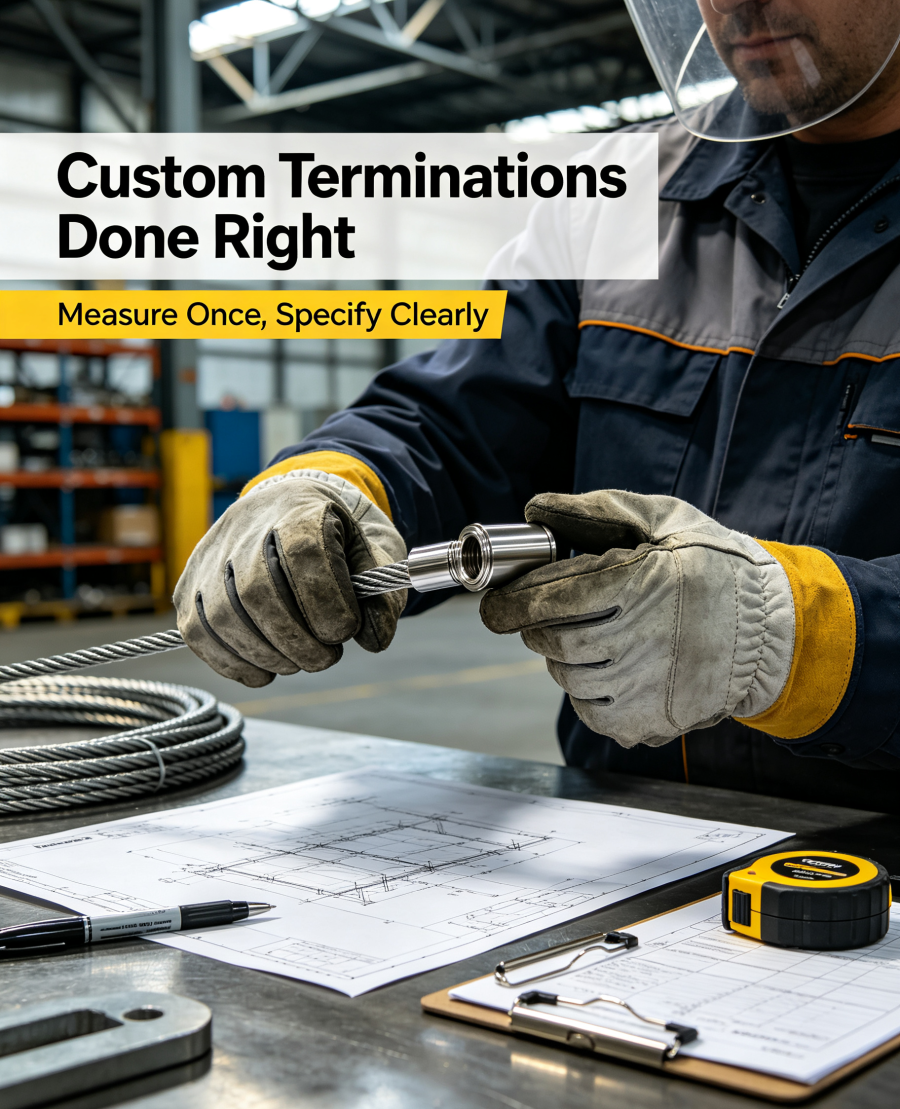
How to Specify Custom Terminated Wire Rope Without Costly Mistakes
Ordering custom terminated wire rope sounds simple until you receive an assembly that does not fit, cannot be installed, or lacks the documentation your inspector requires. A single unclear dimension or missing material callout can delay a project by weeks. The good news is that most of these mistakes are avoidable once you know what to specify up front. This guide walks you through the essential decisions: end fittings, measurement methods, materials, standards, and the details that belong in every RFQ.
Key Takeaways:
- Custom terminated wire rope is a complete assembly, not just a cut length of cable.
- Length, fitting orientation, material, and documentation must be specified before quoting.
- Small measurement errors cause the most common and most expensive ordering problems.
- Always ask for proof testing and traceability when the assembly is load-bearing or safety-related.
What Custom Terminated Wire Rope Actually Means
Custom terminated wire rope is a complete assembly made from wire rope plus one or more attached end fittings. The fittings are permanently or mechanically secured to both ends, or sometimes to one end only. You specify the exact combination of cable, fittings, length, and finish. The supplier builds the assembly to your written requirements.
You should choose a custom assembly when a standard cable assembly cannot meet your needs. That typically happens when you need a specific end-to-end length, a particular fitting style, a higher load rating, or documentation such as proof testing and material certificates. Custom does not always mean expensive. It means the assembly is built from defined specifications rather than pulled from stock.
The real advantage of a custom assembly is control. When you buy stock cable, you inherit whatever design choices the manufacturer made for a general-purpose market. When you specify custom, you control load path, corrosion resistance, fit-up tolerance, and the paperwork trail. In load-bearing and structural applications, that control is not a luxury. It is the difference between a part that installs cleanly and passes inspection versus one that gets red-tagged on site.
Where Standard Cable Assemblies Fall Short
Stock cable assemblies often come in set lengths with generic fittings. That works for light-duty applications or prototyping. But in structural support, lifting, rigging, and architectural tension systems, an off-the-shelf assembly rarely fits correctly. You may end up with extra slack, the wrong thread size, or a fitting that cannot rotate into position. Custom terminated wire rope lets you control each detail so the part installs correctly the first time.
Consider a railing project where the posts are already drilled at 35-1/2 inches between hole centers. A 36-inch stock assembly will not fit, and a 34-inch one leaves an unsafe gap. The custom assembly is built to match the hole-to-hole dimension exactly. That is why fabricators and installers order custom length assemblies even when the individual components are stocked items.
Key Parts of a Terminated Wire Rope Assembly
Every custom assembly includes several core elements:
- Wire rope — the flexible steel cable that carries the load
- End fittings — the terminals attached to the rope ends, such as eyes, forks, or threaded studs
- Optional sleeve or coating — plastic or nylon covering used for protection, wear resistance, or aesthetics
Some assemblies also include intermediate fittings, turnbuckles, or stops. When you specify a custom assembly, you are defining all of these parts together, not just selecting a cable diameter.
Think about how all the parts interact before you finalize the RFQ. For example, a swaged fork fitting adds length beyond the bare rope end, and a plastic sleeve over the rope can change the effective diameter that passes through a hole or clamp. If you specify the wire rope diameter but forget to account for the sleeve thickness, you may end up with an assembly that does not fit through the opening in your structure. The supplier builds what you ask for, not what you meant.
Common End Fittings and Where They Work
The right end fitting depends on how the assembly connects to the surrounding structure. Start with the connection point, not the fitting name. Ask yourself what the fitting attaches to, what direction the load travels, and whether the fitting must allow rotation or adjustment. Once you know that, fitting selection becomes much easier.
Eyes, Forks and Threaded Studs
- Eye terminals are loop-shaped fittings that accept a pin, bolt, or shackle. They work well when the connection point allows side-to-side movement. Use them in lifting slings, guy wires, and general rigging.
- Fork terminals are clevis-style fittings with two flat sides and a hole. They fit around a mounting tab or bracket. Forks resist twisting and keep the assembly aligned in one plane.
- Threaded studs screw into a tapped hole or accept a nut. They are common in architectural tension systems, railings, and adjustable linkages.
- Ball terminals fit into socket-style anchors and show up often in push-pull control cables and structural tensioning.
- Turnbuckles are not end fittings in the strict sense, but they are often included in custom assemblies to provide length adjustment and tensioning after installation.
Choose the fitting that matches the mounting hardware already on your project. Changing a fitting later usually means rebuilding the entire assembly.
Here is a practical example. Suppose you are replacing a broken cable on a boat lift. The old assembly had a fork terminal on both ends, each connecting to a welded tab with a 1/2-inch pin hole. You find a stock cable with the right length and diameter, but it has eye terminals instead of forks. The eyes will physically fit over the tabs, but they will twist sideways under load, wear the galvanized coating unevenly, and eventually fail at the fitting. The correct move is to order a custom assembly with forks at both ends, aligned in the same plane. Matching the fitting type to the existing connection geometry is what prevents premature failure.
Swaged, Mechanical and Spelter Terminations
How the fitting attaches to the wire rope matters just as much as the fitting shape. The three main termination methods have different strength and fatigue characteristics.
- Swaged terminations use a hydraulic press to compress a metal sleeve around the wire rope. This is the most common method for stainless steel wire rope assemblies. Swaged fittings produce a clean, permanent connection with high efficiency when properly made.
- Mechanical terminations use wedges, clamps, or screws to grip the rope. They allow field assembly and adjustment but generally have lower strength ratings than swaged fittings. Use them when the assembly may need to be reworked or when swaging equipment is not available.
- Spelter terminations use molten zinc or resin poured into a fitting socket to lock the rope in place. Spelter sockets are common on large-diameter lifting ropes and heavy rigging. They require specialized equipment and careful process control.
For most custom assemblies under 1 inch in diameter, swaged fittings offer the best balance of strength, size, and cost.
A properly swaged fitting retains a high percentage of the wire rope's breaking strength, whereas a poorly fitted mechanical clamp may slip at a much lower load. The trade-off is that swaged fittings cannot be adjusted in the field. If your installation has uncertain geometry and you may need to fine-tune length on site, a mechanical termination can be the safer practical choice, even if its rated capacity is lower. Think of swaged as "set at the factory," and mechanical as "tunable in the field."
How to Measure and Specify Length Without Errors
Length errors are the number one reason custom wire rope assemblies get rejected or reworked. The problem is not usually the tape measure. It is that people use different reference points when they call out a length. You need to define length the same way your supplier does.
Overall Length vs. Clear Length
- Overall length is measured from the extreme end of one fitting to the extreme end of the other. For eyes and forks, this means the outermost tip of the terminal.
- Clear length is the distance between the inside contact surfaces of the fittings. For two eye terminals, clear length is the distance between the inside edges of the loops.
- Hole-to-hole length is the distance between the centers of the pin holes in two fittings. This is often the most useful dimension because it matches the mounting points on your structure.
When you write a dimension, state exactly what it represents. A drawing or sketch removes ambiguity. If you only write “length: 24 inches,” the supplier has to guess whether you mean overall, clear, or hole-to-hole. Guessing is how expensive mistakes happen.
Picture an installer on a jobsite holding a new wire rope assembly against a gate frame. The fork holes do not line up with the brackets, no matter how the fitting is rotated. The assembly is half an inch too short. The problem is not manufacturing error. The buyer measured overall length, but the supplier interpreted the number as hole-to-hole length. The difference between those two reference points, often just the length of the fork itself, is enough to make the part impossible to install. A hand sketch with an arrow pointing to the hole centers would have prevented the entire delay.
To avoid this specific error, use two dimensions when the fitting geometry is at all complex: overall length and hole-to-hole length. When both are written on the RFQ, the supplier has two checkpoints to confirm the end-to-end relationship. If only one dimension is given, state explicitly which one it is. When in doubt, include a photo or PDF drawing with the requested length dimensioned on the image, not just typed in the body of the email.
Diameter, Tolerance and Direction of Fittings
Wire rope diameter can be specified as nominal or actual. Nominal diameter is the design size, like 1/4 inch. Actual diameter may measure slightly larger or smaller depending on the strand construction and measurement method. In most cases, nominal diameter is sufficient for ordering. But if the rope passes through a tight hole or seal, specify the maximum allowable actual diameter.
Fitting orientation also matters. Two eyes on the same assembly may need to lie in the same plane or at 90 degrees to each other. Threaded studs may need a specific thread direction, such as right-hand or left-hand. If the fitting must clock to a particular angle, write that down. Use words like “both eyes in same plane” or “forks aligned at 90 degrees to each other.” Do not rely on the supplier to infer it.
Tolerances should match the application. A handrail cable may tolerate plus or minus 1/8 inch. A structural tension member may need plus or minus 1/16 inch or less. Tighter tolerances raise cost, so specify only what the installation actually requires.
One of the most common and frustrating mistakes is specifying a tolerance that is impossible to achieve with the chosen end fittings and manufacturing process. For example, asking for plus or minus 0.010 inch on a swaged fork assembly is unreasonable unless the supplier offers a post-swage machining step. A better approach is to design the connection with a small adjustment range, such as a threaded stud with a jam nut, so that the assembly itself can absorb small variations. That way you are not paying a premium for a tolerance the application does not truly need.
Material and Finish Choices That Affect Performance
Material choice affects strength, corrosion resistance, life span, and price. The right material depends on where the assembly will live and what it will be exposed to. Think environment first, then strength, then cost.
Stainless Steel vs. Galvanized Wire Rope
Stainless steel wire rope is the standard choice for outdoor, marine, food, and architectural applications. Type 304 stainless works well in most atmospheric and freshwater environments. Type 316 stainless adds molybdenum for better resistance to saltwater and chemicals. Stainless rope typically costs more than galvanized but requires less long-term maintenance.
Galvanized wire rope has a zinc coating that protects the underlying steel. It costs less and offers good strength, but the coating will eventually wear or corrode in aggressive environments. Use galvanized rope for indoor, temporary, or budget-sensitive applications where appearance and long-term corrosion resistance are not critical.
Strength ratings are similar for the same diameter and construction, but corrosion changes effective life span. A galvanized assembly exposed to salt spray may degrade much faster than a 316 stainless assembly, even if both started with the same breaking strength.
Here is a real-world distinction that often gets overlooked. Type 304 stainless is an excellent general-purpose material, but it can still develop pitting and staining in environments with chloride exposure, including coastal air, road salt, and even some indoor pools. If the assembly will live within a few miles of saltwater or will be cleaned with chlorinated products, step up to 316. The added material cost is small compared to the labor of replacing a failed cable in a hard-to-reach location.
Coatings, Lubrication and Corrosion Protection
Plastic or nylon coatings add a protective layer over the wire rope. They improve grip, reduce abrasion, and keep the rope from scratching surrounding surfaces. Common coating materials include PVC, nylon, and polyethylene. Coatings also trap moisture if damaged, so do not use a coated rope where inspection of the steel surface is required.
Lubrication matters for internal rope health. Most wire ropes ship with a light lubricant to reduce internal friction between strands. In food or cleanroom applications, you may need a dry or food-grade lubricant — or no lubricant at all. State the requirement clearly if the assembly is used near food, painted surfaces, or sensitive equipment.
Temperature and chemical exposure also drive material decisions. High heat can break down plastic coatings and lubricants. Strong acids or alkalis can attack stainless steel or zinc. When in doubt, describe the service environment in the RFQ and let the supplier recommend an appropriate material.
One subtle failure mode to be aware of is moisture trapped under a plastic coating. If the coating gets nicked or punctured during installation, water can enter and sit against the steel surface, causing hidden corrosion that the coating itself conceals. In marine or outdoor washdown environments, an uncoated 316 stainless assembly that can be visually inspected may outlast a coated galvanized one that hides damage until it breaks. Choose coatings for obvious mechanical benefits, not as a substitute for base corrosion resistance.
Standards, Testing and Documentation to Request
Documentation is not paperwork for its own sake. It is evidence that the assembly performs as specified and can be traced back to its raw materials. For lifting, rigging, and structural applications, skip this section at your own risk.
Proof Testing and Load Ratings
Load capacity is not the same as breaking strength. Breaking strength is the force at which the rope fails. Load capacity is the safe working load, which includes a safety factor. For lifting applications, a common safety factor is 5:1, meaning the breaking strength must be at least five times the intended load. For architectural tension systems, the required factor may be lower or higher depending on the design code.
Proof testing applies a specific load to the completed assembly to verify that it does not fail or deform. After proof testing, the supplier typically issues a certificate showing the test load and result. Request proof testing when the assembly is safety-critical or when your customer or inspector requires it. Not every assembly needs proof testing. For light-duty non-critical use, a material certificate may be enough.
The reason to request proof testing before production is simple: it is cheaper to catch a defective swage at the factory than to have a cable pull out of its fitting on site. A proof test does not replace proper design and inspection, but it provides documented evidence that each completed assembly was loaded to a specified value and survived. For structural or overhead applications, that certificate is often the first thing an inspector asks for.
Certificates and Traceability
Ask the supplier what documents they can provide before you place the order. Common items include:
- Material test reports showing the chemical and mechanical properties of the steel
- Proof test certificates for the completed assembly
- Certificates of conformance confirming the assembly meets your stated specification
- Traceability documents linking the rope and fittings to their heat or lot numbers
Relevant standards may include ASTM standards for wire rope and fitting materials, ASME standards for lifting and rigging hardware, and industry-specific codes for marine, construction, or transportation. You do not need to become a standards expert. You do need to ask the supplier which standards apply to your application and request the corresponding documentation.
A practical lesson from the field: request the documents during the quoting stage, not after the parts arrive. Suppliers may charge extra to produce certificates after the fact, and some lot traceability information is only available at the time of manufacture. If you know an inspector will ask for papers, put the documentation requirement directly in the RFQ line items. That way the quote includes the cost and the supplier cannot claim it was an add-on.
A Practical Ordering Checklist Before You Submit Your RFQ
The best way to avoid custom order mistakes is to gather the right information before you write the RFQ. A vague request like “need custom wire rope” forces the supplier to ask follow-up questions or make assumptions. A complete specification gets you an accurate quote and a part that fits.
Questions to Confirm With Your Supplier
Before you send the RFQ, confirm these details:
- Assembly length — overall, clear, or hole-to-hole, with tolerance
- Wire rope diameter — nominal or maximum actual
- Wire rope material — stainless steel or galvanized, grade if known
- End fitting type and size — eye, fork, stud, ball, or other
- Fitting orientation — same plane, 90 degrees, or specific clocking
- Load requirement — working load, safety factor, or required breaking strength
- Environment — indoor, outdoor, marine, chemical, high heat
- Quantity — final quantity plus any prototype or sample needs
- Documentation — proof test, material certs, traceability
A simple way to keep this list manageable is to sketch the assembly by hand, even roughly, and dimension the sketch itself. Draw the two end fittings as you expect them to sit in the installed position. Mark the hole centers and the overall end-to-end length. Note the material and grade next to the rope. Then send the sketch along with the RFQ. This one habit eliminates most of the ambiguity that causes custom order delays.
Common Mistakes That Delay Custom Orders
The most common delay comes from missing specifications. A drawing with no dimensions, a photo with no part numbers, or an email that says “make it like the last one” all force back-and-forth clarification. Specifying an unrealistic tolerance is another frequent issue. If you ask for plus or minus 0.005 inch on a 20-foot assembly, expect a higher price and longer lead time.
Forgetting fitting orientation is especially costly because the assembly may be impossible to install even if the length is correct. Always include a simple sketch, even a rough one. A hand-drawn picture with clear reference points is better than a perfect sentence that leaves room for interpretation.
One more mistake that routinely costs buyers time and money: reusing an old part number without confirming the drawing revision. Suppliers track part numbers and revisions for a reason. If your last order was 24 inches hole-to-hole with 304 stainless fork ends, and the new project needs 26 inches with 316 stainless stud ends, do not simply resend the old RFQ and hope the supplier notices the change. Issue a new revision with the new dimensions highlighted. It feels like extra work up front, but it is far less work than returning a batch of assemblies that were built exactly to the old spec.
Review the checklist above before you submit your next RFQ. It helps you capture every dimension, material, fitting, and document requirement so you can order with fewer errors and fewer delays.
Frequently Asked Questions
What Is the Difference Between Overall Length and Hole-to-Hole Length on a Custom Terminated Wire Rope?
Overall length is measured from the extreme outer ends of both fittings, while hole-to-hole length is measured between the centers of the pin holes in fittings like eyes or forks. Hole-to-hole length is often the most useful because it matches the mounting points on the structure. Always state which measurement you are using on the RFQ to avoid ordering errors.
How Do I Choose Between Stainless Steel and Galvanized Wire Rope for a Custom Assembly?
Stainless steel, especially grade 316, is the better choice for outdoor, marine, or chloride-exposed environments because it resists corrosion more effectively. Galvanized wire rope costs less and can work for indoor or temporary applications where long-term corrosion resistance is less critical. For coastal or washdown conditions, 316 stainless is usually worth the added material cost.
What Documentation Should I Request for a Custom Terminated Wire Rope Assembly?
Request material test reports, proof test certificates, certificates of conformance, and traceability documents linking the rope and fittings to their heat or lot numbers. Ask for these documents during the quoting stage rather than after parts arrive, especially for lifting or structural applications. This gives inspectors the evidence they need and avoids post-order delays or extra charges.
What Is the Difference Between Swaged and Mechanical End Terminations on Wire Rope?
Swaged terminations use a hydraulic press to compress a metal sleeve around the rope, creating a permanent and high-strength connection. Mechanical terminations use wedges, clamps, or screws and allow field adjustment but generally have lower strength ratings. Choose swaged for factory-set assemblies and mechanical when length may need adjustment on site.
Why Does Fitting Orientation Matter When Ordering Custom Terminated Wire Rope Assemblies?
Fitting orientation controls whether two eyes or forks lie in the same plane, at 90 degrees, or at a specified clocking angle. If orientation is not stated, the assembly may arrive impossible to install even when the length is correct. Include a simple sketch or a clear note like "both eyes in same plane" on the RFQ.
Tags:custom coated wire rope | hanging wire rope | industrial wire rope
0users like this.