


news
The Honest Guide to Choosing a Carabiner Pen Reel That Actually Lasts
You have probably owned a retractable badge reel that worked great for two weeks and then turned into a tiny plastic brick. The spring went soft. The cord frayed. The clip snapped when you caught it on a door frame. A carabiner pen reel looks like a simple product, but the difference between one that lasts two months and one that lasts two years comes down to a few details most buyers never check.
That is exactly what this guide covers. You will learn how to evaluate the spring mechanism, cord durability, gate strength, and mounting style before you spend money. No vague product roundup. No fake "top 10" list. Just the practical checks that help you choose a carabiner pen reel that holds up to real daily use.
Key Takeaways:
- Match the reel's weight rating to the heaviest item you actually carry, not the lightest.
- Check the spring tension and cord thickness before you trust a reel with a work badge or keys.
- Mount the reel to a stable belt loop or bag strap, not a flimsy plastic badge clip.
- Inspect the cord and carabiner gate weekly for early signs of wear.
- Download the free Carabiner Pen Reel Pre-Purchase Checklist before comparing products.
What Is a Carabiner Pen Reel, and Why Would You Use One?
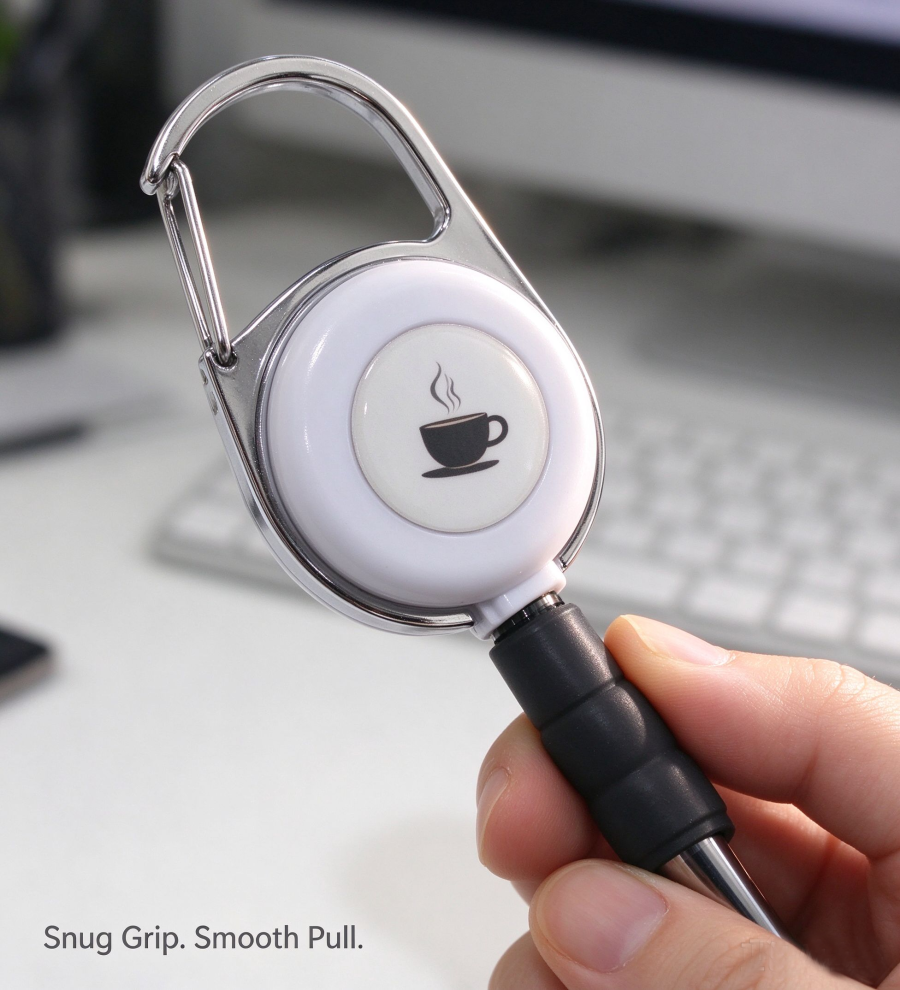
A carabiner pen reel is a compact retractable cord with a carabiner clip on one end and a small pen-shaped housing for the spring mechanism. The carabiner clip lets you attach the reel to a belt loop, bag strap, or keychain. The retractable cord extends when you pull the attached item toward you, then retracts automatically when you let go.
People use carabiner pen reels for everyday carry and workplace gear. A nurse clips one to scrubs for a work badge. A warehouse worker uses one for a security card or small tool. An outdoor enthusiast clips keys or a multi-tool to a pack. Office workers use them for ID badge holders that need to reach a door scanner without unhooking anything.
You would choose a carabiner style over a standard badge reel for one main reason: the carabiner clip opens and closes around loops that a fixed plastic clip cannot grip. It works well on thick straps, D-rings, and tighter attachment points. Just remember that the carabiner gate is a moving part too. It needs inspection just like the cord and spring.
Here is something most buyers do not realize until it is too late: the spring inside a retractable reel is a consumable part. Every pull and retraction cycles the spring, and cheap springs lose tension after a few hundred cycles. This is why two reels can look identical on the packaging yet perform completely differently in the field. When you choose a reel, you are not really picking a cord and a clip. You are picking a spring that will either hold its tension or slowly go limp.
How to Choose the Right Carabiner Pen Reel for Your Daily Carry
Start with the weight and cord length you need. Then check the materials that determine whether the reel survives your daily environment.
Check the Weight Rating and Cord Length
Many cheap carabiner pen reels list a weight rating that sounds generous but only applies when the cord hangs straight down. If you pull at an angle or yank the cord, the internal spring mechanism takes far more stress than the rating suggests.
Match the reel's weight rating to the heaviest thing you carry, then add a little margin. For keys, a small flashlight, and a work badge, a reel rated for 3–5 oz may work. For a multi-tool or a heavier keychain, look for 6–8 oz or more. If the seller does not list a weight rating, treat that as a warning sign.
Cord length matters too. A 24–30 inch cord gives you room to pull a badge to a scanner without leaning. A 12–18 inch cord keeps items close to your body and reduces snag risk. For EDC gear on a backpack strap or belt loop, shorter cords usually perform better because they do not swing as much.
Here is a quick way to estimate what you actually need. Put everything you plan to attach to the reel on a kitchen scale. That is your baseline weight. Now think about how you pull the reel in real life. Do you pull straight out, or do you tug at an angle while walking? If you tug at an angle, the spring sees more force than the scale showed. Add 2–3 oz of buffer on top of your measured weight, and buy a reel that clears that number comfortably. You will never regret buying a little too much capacity, but you will definitely regret buying too little.
Look at the Carabiner Gate and Housing Material
The carabiner clip is the most overlooked failure point. A wire gate with weak spring tension can pop open when the reel twists or presses against your body. Look for a gate that snaps back firmly when you release it. If it feels mushy in your hand, skip it.
Check the housing too. Aluminum and reinforced nylon housings survive drops and daily friction better than thin ABS plastic. Avoid reels with visible mold seams or flimsy plastic parts around the cord opening. If the housing flexes when you squeeze it, the internal spring mechanism sits in a fragile shell.
Finally, pay attention to the cord material. A nylon cord with a tight weave resists fraying far better than a thin thread or uncoated cord. The cord should retract smoothly without catching at the opening. If you can, extend the cord fully in the store and listen to the spring. A healthy spring retracts evenly. A weak one clunks or stalls.
If you are shopping online and cannot touch the reel, look for close-up photos of the carabiner hinge and the cord opening. A hinge that uses a small screw or pin tends to hold tension longer than a molded plastic flex hinge. A cord opening with a metal or ceramic grommet protects the cord better than a bare plastic hole. If the product photos only show the reel from one angle, that is often a sign the seller is hiding the weakest part of the design.
One more thing about spring quality: a good spring retracts with steady tension all the way from full extension to full retraction. A cheap spring starts strong near full extension and then dies before the cord seats fully. That dead zone means your badge hangs loose against your shirt instead of sitting tight against the reel. If you can test the reel in person, pull the cord out slowly and let it retract while watching the last inch. The last inch tells you more about longevity than the first ten.
Common Mistakes That Kill a Carabiner Pen Reel Early
Most early failures come from two habits: overloading the spring and ignoring early signs of wear. Both are easy to avoid.
Overloading the Retraction Mechanism
You attach more than the reel can handle. Maybe you add a chunky keychain to the same reel that holds your work badge. Maybe you pull the cord all the way out and let it snap back hard. Over time, the spring loses tension. The cord stops retracting fully and hangs loose at your hip.
Respect the weight rating and avoid yanking the cord to full extension. A short, steady pull is gentler on the spring mechanism than a fast snap. If you regularly need to reach far, buy a reel with a longer cord instead of stretching a short one to its limit.
Here is the mistake most people do not see coming: they use the reel as a fidget toy. You know the habit—pull the cord out, let it snap back, pull it out again. Maybe you do it while thinking, while waiting, while talking on the phone. Every one of those snaps is a full stress cycle on the spring and the internal stop. Fifty snaps a day adds up to over 18,000 cycles a year. No budget reel survives that. If you catch yourself fidgeting with the cord, switch to a keychain or pen instead. Your reel will thank you.
Ignoring Cord Fray and Spring Resistance
The cord starts to fray at the opening where it rubs against the housing. You notice a few broken threads but keep using it. One day the cord snaps while you are pulling your ID badge holder toward a door reader. Now you are holding a broken reel and your badge is still clipped to the reel.
Check the cord weekly. Look for fuzzy spots, discolored sections, or kinks that do not straighten out. Also test the spring resistance. Pull the cord out and let it retract slowly. If it hesitates, stutters, or stops halfway, the spring mechanism is wearing out. Replace the reel before it fails completely.
Another quiet killer is cord twist. When you let the cord snap back, it can spin and wrap around itself inside the housing. A twisted cord rubs against the opening at a bad angle, which accelerates fraying. The fix is simple: after every few pulls, let the cord retract gently and give the housing a little shake so the cord seats straight. If the cord already has a visible twist, pull it all the way out, straighten it with your fingers, and let it retract slowly. Doing this once a week reduces the kind of wear that turns a small fray into a sudden snap.
Best Ways to Mount and Carry a Carabiner Pen Reel
How you mount the reel changes how long it lasts and how easy it is to use.
On a Belt Loop or Bag vs. Directly on a Badge
Attach the carabiner clip to a stable anchor point. A belt loop, bag strap, D-ring, or backpack webbing works well. The carabiner stays put and the reel housing moves with your body.
Avoid clipping the carabiner directly to a thin badge holder or lanyard clip. Those flimsy plastic parts flex and snap under the constant pull of the reel. The carabiner gate may also twist open when attached to an unstable point. If you carry a work badge, clip the reel to your belt loop or shirt pocket, then attach the badge to the cord end. That way the badge hangs where you need it without stressing the mounting point.
Why does mounting location matter so much for longevity? Because the carabiner gate rubs against whatever it touches all day. If the gate presses against your hip when you sit, opens slightly, and then gets bumped back, the gate spring weakens. Over time, the gate stays open just a little, and then one day the reel falls off and you do not notice until you reach for your badge and grab air. The fix is to choose an anchor point where the carabiner rests flat and the gate is not being pressed sideways. On a belt loop, position the carabiner so the gate faces outward, away from your body. On a bag strap, let the reel hang freely so the gate is not jammed against the webbing.
Quick Access Without Tangling
Keep the cord path short and clean. The cord should travel from the reel housing to the item in a mostly straight line. If the cord wraps around your belt, bag flap, or jacket, it wears faster and retracts poorly.
For quick access, attach the reel where your hand naturally reaches. On a backpack strap, mount it near the chest. On a belt, clip it near the hip you use most. When you pull the item, guide the cord back gently rather than letting it snap. A smooth retraction keeps the cord from twisting and the spring from slamming.
Picture this: you are in a hospital hallway, badge clipped to your scrubs, and you need to swipe into a medication room while holding a tray. If your reel is mounted on the wrong side, you have to set down the tray, twist your body, and pull the badge awkwardly. But if the reel sits on your dominant shoulder or the hip closest to your swiping hand, you can swipe the door with one hand while the other holds the tray. That is the difference between a setup that works for you and one you fight against every day.
Now imagine the same hallway in winter. You are wearing a heavy coat over your scrubs. The coat rubs against the cord every time you move. If the cord is already frayed, that friction is enough to snap it. A coworker watches you tuck the reel under your coat to protect it, and suddenly the setup that worked in July is failing in January. The lesson: think about layers when you choose a mounting spot. If you wear different gear in different seasons, test your reel setup with each one before the season changes.
How to Maintain Your Carabiner Pen Reel So It Lasts Longer
Maintenance takes less than a minute per week, but it doubles the life of a good reel.
After dusty, sweaty, or wet use, wipe down the housing and the carabiner gate with a dry cloth. Dirt collects around the cord opening and gradually acts like sandpaper on the nylon cord. If the gate starts feeling gritty, clean around the hinge with a soft brush.
Let the cord retract slowly instead of snapping it back. Fast retraction slams the internal stop and wears the spring mechanism faster. When you are done using the reel, try to store it with the cord mostly retracted and the spring relaxed. Keeping the cord fully extended overnight weakens the spring.
Every few weeks, extend the cord completely and check for damage along the full length. If you see fraying near the clip end, trim the cord or replace the reel before it fails in the field.
Here is a maintenance habit that costs nothing but pays off: clean the cord opening after rain or snow. A wet cord picks up grit, and that grit gets dragged into the housing on every retraction. Once grit gets inside, it grinds against the spring and the internal stops. You cannot open most sealed housings to clean inside, so the only solution is to keep grit out. After wet use, extend the cord fully, wipe it down with a dry cloth, and let it air dry before retracting. If the cord is soaking, give it an hour to dry before the next use.
Also worth doing: test the gate spring weekly. Open the carabiner gate with your thumb and let it snap closed. It should close with a firm, audible click. If it closes slowly or does not fully seat, the gate spring is failing. You can sometimes clear small debris from the hinge with a toothpick or a can of compressed air. If that does not restore the snap, retire the reel. A carabiner that does not stay closed is not a carabiner; it is a hook waiting to drop your gear.
Quick Pre-Purchase Checklist for a Carabiner Pen Reel
Before you compare products online or in a store, run through this list.
First, verify the weight rating. Match it to what you actually carry. Second, check the cord length you need for your workflow. Third, test the carabiner gate tension if you can. Weak gates fail fast. Fourth, look at the housing material and build quality. Aluminum or reinforced nylon beats thin plastic. Fifth, inspect the nylon cord weave and how smoothly it retracts. Sixth, think about where you will mount it and whether that anchor point is stable.
Here is how to use this checklist in a real shopping moment. Imagine you are standing in a store with two reels in your hands. Reel A is $6, weighs almost nothing, has a thin plastic clip, and the packaging does not mention a weight rating. Reel B is $14, has an aluminum carabiner, a reinforced nylon cord, and a listed rating of 8 oz. You are tempted to save the $8. But think about the last cheap reel you replaced. How many hours did it waste? How much did it cost to replace? Suddenly the $8 difference looks smaller than the cost of buying twice. The checklist helps you make that calculation quickly, in the store, instead of after the cheap reel fails.
This checklist takes a few minutes and saves you from buying another disposable reel. If you want a printable version to keep in your pocket while you shop, download the free Carabiner Pen Reel Pre-Purchase Checklist PDF before your next purchase. It includes the exact checks in one simple page.
A carabiner pen reel is a small piece of everyday carry gear, but it earns its place when it works without you thinking about it. The cheap ones fail quietly, one frayed thread at a time. The good ones last because you choose carefully and maintain a little. Now you know how to do both.
Frequently Asked Questions
What weight rating should I look for in a carabiner pen reel?
Choose a weight rating that matches the heaviest item you actually carry, then add 2–3 oz of buffer. For keys, a small flashlight, and a work badge, a 3–5 oz rating usually works. For multi-tools or heavier keychains, look for 6–8 oz or more.
Why won't my retractable carabiner pen reel retract all the way?
The spring inside the reel is a consumable part that loses tension over time, especially if the reel is overloaded or the cord is repeatedly snapped back hard. Dirt and grit around the cord opening can also cause hesitation or stalling. If the cord no longer retracts smoothly to the last inch, it's time to replace the reel.
How do I keep the cord on my carabiner pen reel from fraying?
Let the cord retract slowly instead of snapping it back, and straighten any visible twists weekly. Wipe the cord down after wet or dusty use to keep grit from acting like sandpaper on the weave. If you notice fuzzy spots or broken threads, replace the reel before the cord snaps in the field.
Where is the best place to attach a carabiner pen reel?
Attach the carabiner to a stable anchor point like a belt loop, bag strap, D-ring, or backpack webbing. Avoid clipping it to thin plastic badge holders or lanyard clips, which can flex and snap under constant pull. Position the carabiner so the gate faces outward and isn't pressed sideways against your body.
0users like this.